
В журнале The Journal of Physical Chemistry B (импакт-фактор 3,2) опубликована статья, соавторами которой являются ученые из Института химической биологии и фундаментальной медицины им. Д.Г. Кнорре СО РАН и Новосибирского института органической химии им. Н.Н. Ворожцова СО РАН (к.х.н. С.С. Овчеренко, И.А. Литвинов, к.х.н. А.В. Шернюков, Д.А. Кузнецов, к.х.н. И.А. Кирилюк, д.ф.-м.н., проф. Е.Г. Багрянская):
Probing Electrostatics in a DNA Repair Enzyme with a pH-Sensitive Nitroxyl Spin Label
Sergey S. Ovcherenko, Nikita A. Bulgakov, Ivan A. Litvinov, Andrey V. Shernyukov, Danil A. Kuznetsov, Anton V. Endutkin, Timofey D. Zharkov, Maxim S. Kupryushkin, Igor A. Kirilyuk, Dmitry O. Zharkov, Elena G. Bagryanskaya
J. Phys. Chem. B, 2026, 130,13, 3603-3616
Abstract
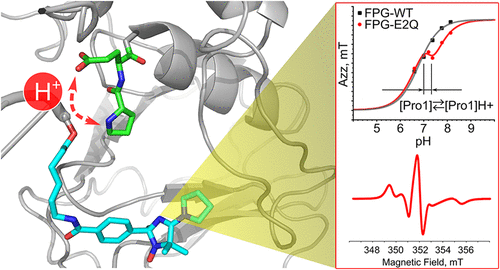
Enzymes use electrostatic interactions to recognize their substrates, preorganize active sites, and stabilize reaction transition states. Formamidopyrimidine–DNA glycosylase (Fpg) is a bacterial enzyme that repairs a pro-mutagenic DNA lesion, 8-oxoguanine; its human homologues are important for cancer prevention. General acid–base catalysis in the active site of Fpg requires a finely tuned proton transfer between Pro1 and Glu2 residues. To assess the protonation state of the active site experimentally, we used EPR spectroscopy with a novel imidazolidine nitroxyl spin label responsive in the physiological pH range. The label showed excellent sensitivity in detecting DNA duplex formation and Fpg binding, allowing us to measure changes in the local electrostatic potential. We constructed DNA duplexes placing the spin label near the active site, as verified by EPR and molecular dynamics. Comparing the pH response of the label bound to wild-type Fpg and its catalytically dead E2Q mutant, we observed a notable deviation at pH 7.00 and above, which provides experimental evidence for a mutation-induced shift in the local electrostatic potential at the spin label site. Thus, our approach allows indirect but sensitive probing of the ionization state of key catalytic residues. This work demonstrates that pH-sensitive spin labels hold great potential for exploring electrostatic interactions in DNA–protein complexes, where fine-tuning of local charge is critical for function.