В журнале ChemPlusChem (импакт-фактор 2,4) опубликована статья, соавторами которой являются ученые НИОХ СО РАН: из лаборатории гетероциклических соединений (к.х.н., снс ЛГетС, Е.А. Радюш, к.х.н, мнсн ЛГетс Ю.С. Косенкова, к.х.н., завлаб ЛГетС Н.А. Семенов, д.х.н., гнс ЛГетС А.В. Зибарев и к.х.н., рук. группы ГОС Е.В. Карпова . Статья написана в кооперации с учёными из ИНХ СО РАН и ИОХ РАН.
Показано, что заглавные пи-гетероциклы позволяют легко создать эффективное варьируемое спин-орбитальное взаимодействие - квантово-механический феномен, важный для оптических ("эффект тяжелого атома") и магнитных ("кантинг спинов") свойств, в 5 из 11 атомных центров.
Polyhalogenated 2,1,3-Benzochalcogenadiazoles: A Small-Molecule Platform for Multicentered Spin–Orbit Coupling Affecting Optical Properties (Chalcogens = S, Se, Te; Halogens = F, Cl, Br, I)
Ekaterina A. Radiush, Taisiya S. Sukhikh, Yulia S. Kosenkova, Ivan S. Golovanov, Elena V. Karpova, Nikolay A. Semenov, Andrey V. Zibarev
ChemPlusChem, Volume27, Issue15, 14 August 2026, e70524
doi: 10.1002/cphc.70524
Abstract
2,1,3-Benzochalcogenadiazoles and their halogen derivatives (chalcogen = S, Se, Te; halogen = F, Cl, Br, I) are widely employed in organic optoelectronics as chromophoric/fluorophoric electron-acceptor building blocks. In this work they are specified as an advantageous small-molecule platform for multicentered (Se, Te; Cl, Br, I) spin–orbit coupling (SOC) affecting optical properties of π-organics. Electronic absorption and emission/photoluminescence spectra of 4,7-di- and 4,5,6,7-tetrahalogenated 2,1,3-benzochalcogenadiazoles E/X’ and E/X, respectively (E = chalcogen, X = halogen), have been studied in solid-state and THF solutions experimentally and theoretically. It has been found that the nature of E is the key factor controlling the photophysical properties of E/X’ and E/X, such as energy levels, Stokes shifts, and the photoluminescence quantum yields, while X serves for further fine tuning of the properties. Combined E and X variation allows target-oriented design of absorptive and emissive materials for metal-free SOC-controlled optoelectronics and emerging spin–orbitronics.
Graphical Abstract
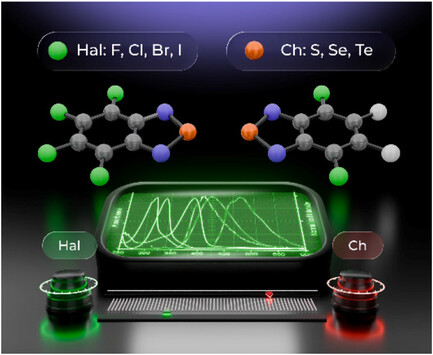
The nature of chalcogen Ch plays a crucial role in the photophysical properties of halogenated 2,1,3-benzochalcogenadiazoles C6Hal4N2Ch and C6H2Hal2N2Ch, while halogen Hal serves for a fine tuning of the properties (Ch = S, Se, Te; Hal = F, Cl, Br, I). Halogenated 2,1,3-benzochalcogenadiazoles are proposed as a small-molecule platform for the design and synthesis of materials for metal-free organic optoelectronics with strong multicentered spin–orbit coupling inherent in heavy atoms (Se, Te, Br, I).