На сайте издаваемого Royal Society of Chemistry журнале CrystEngComm (IF=2,4) опубликована статья сотрудников НИОХ СО РАН ( снс(кхн) Т.А. Ваганова, ЛГетС; гнс(дхн) Е.В. Малыхин; д.х.н. Ю.В. Гатилов). Соавтор статьи - Н.Крючкова из ИНХ СО РАН.
Статья проливает свет на сложные вторичные связывающие взаимодействия - горячая глобальная тема сейчас, в кристаллах заглавных веществ.
.
Competition between chalcogen [Ch⋯N]2 bonding and hydrogen bonding in crystals of 5,6-disubstituted benzo-2,1,3-chalcogenadiazoles: an X-ray and DFT study
Tamara Vaganova, Yurij Gatilov, Natalia Kryuchkova, Evgenij Malykhin
CrystEngComm (2026), First published: November, 9, 2026
doi: 10.1039/d6ce00770h
Abstract
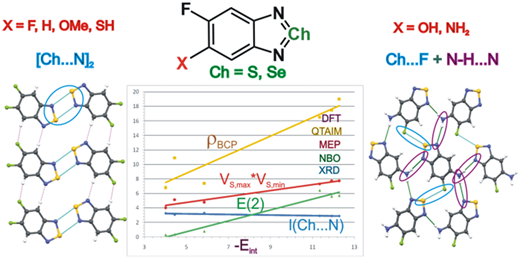
Crystal structures of 5-fluoro-6-R-2,1,3-benzochalcogenadiazoles (Ch = S, Se, R = F, H, OMe, SH, OH, NH2) were studied in detail using XRD and DFT methods. A highly aligned square [Ch⋯N]2 interaction typical of chalcogenadiazoles is realized in the crystals of benzothia- and selenadiazoles containing F, H, OMe and SH substituents. Strong H-bond donors NH2 and OH suppress the formation of the Ch-bonded cyclic synthon; Nhet atoms in these derivatives serve as HB acceptors in the O/N–H⋯N interactions, and Ch atoms form linear Ch⋯F bonds. In addition, crystals contain cyclic or linear C–H⋯N/F contacts. Supramolecular structures based on Ch- and H-bonds are parallel ribbons or intersecting chains depending on the Ch, H-bond donor, and steric factors. These structures are connected via π⋯π and C–F⋯π interactions to form offset stacks. The [Ch⋯N]2 interaction energies increase significantly with S → Se substitution and are unrelated to the substituent electronic nature. The H-bond energies depend on the proton donor and increase by 2–3 times upon the transition from F and OMe to OH and NH2 derivatives. The p/π-electron interactions are comparable in efficiency to H-bonds in C–H⋯N/F cyclic dimers and do not show dependence on the nature of Ch and substituents. These trends are reflected in the calculated MEP, AIM, and NBO descriptors; linear correlations between [Ch⋯N]2Eint and the product of σ-hole potentials VS,max × VS,min, electron density ρBCP, CT energy E(2), and XRD bond length l(Ch⋯N) were revealed.
Visual Abstract